

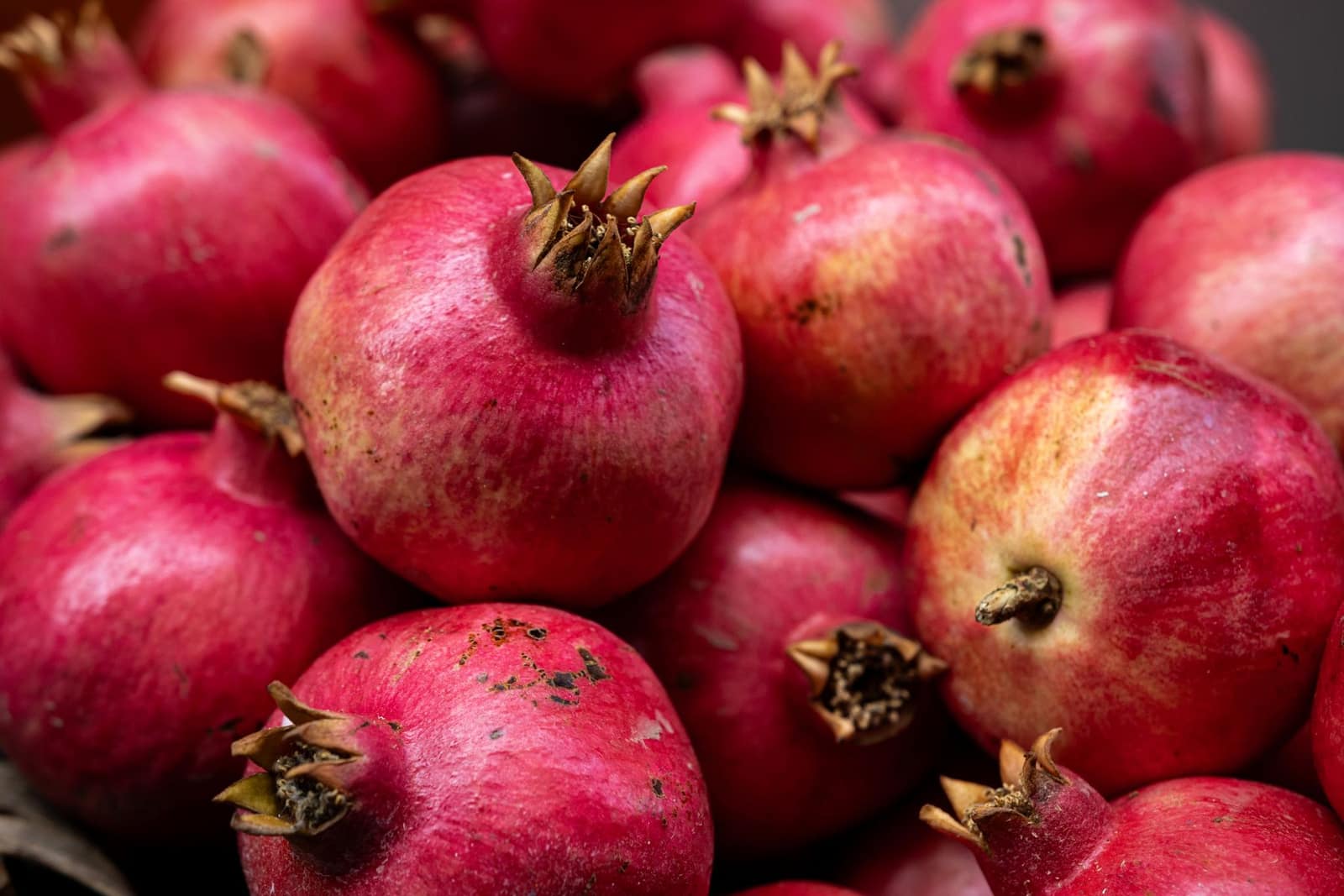
Farm produce
Export fresh pomegranate
Bhagwa pomegranate from Maharashtra for the Gulf, Europe and new markets. AnarNet traceability is required for the EU.
- HS code
- 0810.90 Other fresh fruit, which includes pomegranate. Check the 8-digit line for pomegranate in the current ITC(HS) list.
- Export policy
- Free to export Free. For the EU, farms must be registered and lots tested on AnarNet (part of APEDA HortiNet).
- Registrations
- 5 IEC, GST and those below
- India’s exports, 2025-26
- US$ 121 mn to 53 countries
What is exported
Bhagwa from Solapur, Nashik and Ahmednagar is India’s main export pomegranate, sold as whole fruit and as fresh arils. APEDA lists pomegranate among the larger fresh-fruit exports and counts it in the "other fresh fruits" group, which went mainly to Iraq, the UAE, Uzbekistan, Iran, Nepal and Bangladesh in 2025-26. Canada’s requirements for pomegranate fruit and arils were updated in April 2026.


Varieties, grades and forms
- BhagwaDeep red skin and arils, soft seeds; the main export variety.
- Solapur LalRed-aril variety from ICAR’s pomegranate research centre at Solapur.
- GaneshOlder pale-aril variety, now mostly for the domestic market.
- Fresh arils (ready-to-eat)Packed seeds in punnets, a growing value-added line.
Where it is grown or made
- MaharashtraSolapur (Solapur Pomegranate GI), Nashik, Ahmednagar, Sangli; AnarNet-registered orchards.
- KarnatakaBagalkot, Vijayapura and Chitradurga.
- Andhra Pradesh and GujaratAnantapur; Kutch and Banaskantha.
The quality buyers ask for
- Standard
- Codex pomegranate standard (CXS 310-2013): Extra, Class I and Class II; size by weight or diameter
- Fruit weight
- Buyers order by count per carton; larger fruit earns more
- Aril colour and sweetness
- Deep red arils; total soluble solids checked by refractometer
- Skin
- No cracks, sunburn, bacterial blight spots or bruises
- Residues
- EU lots tested under AnarNet’s residue monitoring plan
Certificates
- AnarNet farm registrationRequiredFarms supplying the EU must be registered on AnarNet, with lot-wise residue testing.
- APEDA RCMCRequiredRegistration with APEDA, issued as an RCMC on the DGFT portal. Since 15 Sep 2026, a consignment up to ₹3 lakh FOB can go without it.
- Phytosanitary certificateRequiredIssued by Plant Quarantine (DPPQS) for each consignment of plant produce, after inspection. Apply on PQMS.
- FSSAI licenceRequiredCentral licence from FSSAI for the premises where the food is packed or stored for export. Apply on FoSCoS.
- GLOBALG.A.P.Often askedFarm-level good agricultural practice certification. Most European supermarket buyers of fresh produce ask for it.
- BRCGS Food SafetyOften askedGFSI-recognised standard asked for by UK and many EU supermarkets for private-label packing.
Shipping, storage and shelf life
40-ft reefers with pallets of 3–5 kg cartons; arils fly in chilled cups.
Sea to the Gulf and Europe; trucks to Bangladesh and Nepal; air for arils and urgent orders.
Typically about 5–7 °C with 90–95% humidity; liners reduce weight loss and shrivelling.
Several weeks for whole fruit in cold chain; arils only days.
What goes on the pack and carton
- Fresh produce cartons for the EU (marketing standards, Regulation 2023/2429): packer’s name and address, produce name and variety, country of origin, class, size code and net weight.
- AnarNet lot number and packhouse code on each carton for EU consignments.
- Gulf countries: Arabic text (Arabic plus English is normal), production and expiry dates, net weight, country of origin and the importer’s details. Confirm the current rules with your importer.
- Lot or batch number on every pack and bag — FSSAI’s Labelling and Display Regulations, 2020 require it, and every importing country uses it to trace and recall.
AnarNet residue sampling is done by APEDA-authorised laboratories (list on apeda.gov.in → Quality → Recognised Organisations). For other markets, use an NABL-accredited lab with pesticide residues in its scope (search nabl-india.org).
Benefits of exporting this product
- RoDTEP refund on this line
Fresh pomegranates (0810 90 10): 2.4% of FOB, capped at ₹2.20 per kg. Rate as listed in Appendix 4R (w.e.f. 10 Oct 2024); DGFT Notification 41/2026-27 keeps the rates in force on 30 Sep 2026 unchanged until 31 Dec 2026. Check your exact 8-digit line on dgft.gov.in before you price.
DGFT — Appendix 4R, RoDTEP schedule for DTA exports w.e.f. 10 Oct 2024 (Notification No. 32, 30 Sep 2024) ↗ - Solapur Pomegranate GI
Solapur Pomegranate is a registered GI listed by APEDA — usable on packs by registered authorised users.
APEDA — Catalogue on Agri and Food GI Products (APEDA scheduled) ↗ - APEDA support (Bharat Krishi Niryat Yojana)
APEDA’s financial assistance scheme for 2026-27 to 2030-31 helps registered exporters, FPOs and processors with packhouses, cold chain and treatment plants, lab testing and quality systems, and market development (trade fairs, trial shipments, brand registration, retail listing fees). Read the component conditions before you spend.
APEDA — Bharat Krishi Niryat Yojana 2026-27 to 2030-31, operational guidelines (6 Oct 2026) ↗
Where to register
- APEDARegistration-cum-Membership Certificate (RCMC) for APEDA-scheduled products. Apply on the DGFT portal after you have your IEC.dgft.gov.in ↗
- Plant Quarantine (DPPQS)Phytosanitary certificate for each consignment of plant produce, applied for online on PQMS. Some markets also need the farm, packhouse or mill to be registered with Plant Quarantine.pqms.cgg.gov.in ↗
- APEDA (AnarNet)Farm registration, residue testing and traceability on AnarNet for EU-bound fruit.apeda.gov.in ↗
Quality and checks
- Pesticide residues within EU or buyer MRLs, lot by lot.
- Freedom from bacterial blight and fruit borer damage; grade by size and colour.
- Market-specific treatment where required (for example irradiation for the USA).
Start with the Gulf by sea in reefers, buying from AnarNet-registered farmers so you can move to Europe later without changing suppliers.
Where new exporters go wrong
- Mixing fruit from unregistered farms into an EU lot — the whole consignment loses traceability.
- Cracked or sun-scalded fruit packed to fill weight; buyers claim on arrival.
Documents this product needs
Schemes that apply
Trade data
Indian fresh pomegranate exports in numbers
From the Department of Commerce’s TradeStat, country by country. US$, Indian financial years (April–March).
- Exports in 2025-26
- US$ 121 mn +8.1% a year on average, 2020-21 to 2025-26
- Change from 2024-25
- ↑ +19% US$ 101 mn → US$ 121 mn
- Buyer countries
- 53
- Average export price
- US$ 1.14 per kg · 1,06,156 tonnes shipped · US$ 1.15 the year before
The price cycle
India’s average export price per kg each year (total value ÷ total quantity). Highest in 2024-25, lowest in 2021-22 — a 30% swing between them. Keep this swing in mind when you quote.
What next: a projection from the trend
The past trend carried forward — not a forecast by any authority. Sudden changes in policy, prices or demand are not in it.
Likely range US$ 89.9 mn to US$ 158 mn.
- Trend
- +5.7% a year
- Fit (R²)
- 0.28 — weak, read with care
- Based on
- 6 years of official figures
Method: a straight line through the logarithm of yearly exports (log-linear regression); range = ±1 standard error.
Biggest buyer countries
By value in 2025-26. Change is against 2024-25.
Where demand is rising and falling
Only countries that buy at least US$ 1 million or 1% of India’s exports of this product. Change from 2024-25 to 2025-26.
↑ High demand
- CanadaUS$ 930k → US$ 1.7 mn↑+81.7%
- SwitzerlandUS$ 1.4 mn → US$ 2.2 mn↑+60%
- Sri LankaUS$ 2.6 mn → US$ 3.8 mn↑+47.8%
- MaldivesUS$ 1.7 mn → US$ 2.5 mn↑+44.4%
- QatarUS$ 2.3 mn → US$ 3.1 mn↑+37.3%
- BelgiumUS$ 1.5 mn → US$ 2 mn↑+33.6%
- United KingdomUS$ 2.6 mn → US$ 3.5 mn↑+33%
- OmanUS$ 2.4 mn → US$ 3.2 mn↑+32.5%
↓ Low demand
No sizeable country falls in this list this year.
New buyers: Countries that bought nothing from India in 2024-25 and did in 2025-26.
- Senegal · US$ 500k
Which forms sell, and at what price
India’s exports by 8-digit tariff line, 2025-26. Average price = total value ÷ total quantity (TradeStat): the average of every shipment on that line, not the price of any one deal.
| Tariff line | Value 2025-26 | Change | Quantity | Average price |
|---|---|---|---|---|
Fruit, edible, fruits in heading no. 0801 to 0810, fresh — pomegranates fresh0810 90 10 | US$ 98.1 mn | ↑+15.7% | 85,032 tonnes | US$ 1.15 per kgwas US$ 1.17 |
Fruit, edible, fruits in heading no. 0801 to 0810, fresh — other fruits, frsh0810 90 90 | US$ 12.7 mn | ↑+38% | 10,381 tonnes | US$ 1.22 per kgwas US$ 1.21 |
Fruit, edible, fruits in heading no. 0801 to 0810, fresh — tamarind fresh0810 90 20 | US$ 5.9 mn | ↑+86.9% | 6,803 tonnes | US$ 0.86 per kgwas US$ 0.76 |
Fruit, edible, fruits in heading no. 0801 to 0810, fresh — custard-apple(ata)0810 90 40 | US$ 1.4 mn | ↑+3.8% | 1,486 tonnes | US$ 0.93 per kgwas US$ 1.03 |
Fruit, edible, fruits in heading no. 0801 to 0810, fresh — sapota (chico)fresh0810 90 30 | US$ 1.2 mn | ↓-10.2% | 918 tonnes | US$ 1.34 per kgwas US$ 1.35 |
Fruit, edible, fruits in heading no. 0801 to 0810, fresh — bore0810 90 50 | US$ 870k | ↓-18.7% | 1,076 tonnes | US$ 0.81 per kgwas US$ 0.83 |
Fruit, edible, fruits in heading no. 0801 to 0810, fresh — lichi0810 90 60 | US$ 340k | ↑+6.3% | 458 tonnes | US$ 0.74 per kgwas US$ 0.60 |
The world market
Each country’s own recorded exports and imports in UN Comtrade, 2023 (the latest year nearly every country has reported).
- World imports
- US$ 3.25 bn 2023
- India among exporters
- #12 of 139 countries
- India’s share of world exports
- 2.2% US$ 79.1 mn
- Left for others to win
- US$ 3.58 bn exported by other countries
Top exporters — your competitors
- 1Viet NamUS$ 929 mn 25.4%
- 2ThailandUS$ 573 mn 15.7%
- 3NetherlandsUS$ 320 mn 8.7%
- 4ChinaUS$ 221 mn 6%
- 5EcuadorUS$ 187 mn 5.1%
- 6EgyptUS$ 147 mn 4%
- 7TürkiyeUS$ 137 mn 3.7%
- 8United Arab EmiratesUS$ 102 mn 2.8%
- 9ColombiaUS$ 98.9 mn 2.7%
- 10SpainUS$ 93.9 mn 2.6%
Biggest buyers in the world
- 1ChinaUS$ 878 mn 27%
- 2USAUS$ 351 mn 10.8%
- 3NetherlandsUS$ 217 mn 6.7%
- 4GermanyUS$ 179 mn 5.5%
- 5FranceUS$ 126 mn 3.9%
- 6China, Hong Kong SARUS$ 126 mn 3.9%
- 7IndonesiaUS$ 110 mn 3.4%
- 8Saudi ArabiaUS$ 98.6 mn 3%
- 9CanadaUS$ 93.5 mn 2.9%
- 10United Arab EmiratesUS$ 89.3 mn 2.7%
Opportunity: what these countries buy from the world, and from India
Each country’s own recorded imports in UN Comtrade, latest year it has reported. The long light part of each bar is demand other countries are filling today.
HS 081090 is “other fresh fruit”; pomegranate is the largest part from India but not all of it. TradeStat’s 2023-24 quantities are double-counted, so that year is left out of the price. Sources: TradeStat — Export Import Data Bank, Department of Commerce · UN Comtrade database (United Nations Statistics Division) · Figures taken 29 October 2026.
Step by step
How to export fresh pomegranate
India is one of the largest pomegranate producers and exporters, mainly of the Bhagwa variety from Maharashtra, Karnataka and Gujarat. Spain, Turkey, Peru, Iran and Egypt compete. Buyers in the Gulf, Bangladesh, Nepal, the Netherlands and the UK value Bhagwa’s deep red arils and long keeping. Openings include the EU through AnarNet, new markets opened by protocol (such as the USA with irradiation), and fresh arils in cups for retailers.
- 01Register farms on AnarNet
For Europe, register farms and follow the approved spray list.
- 02Agree count and cartons
Fix fruit count per carton, carton weight, colour and the price basis with the buyer.
- 03Test residues
Have an APEDA-authorised lab sample and test the plot before harvest.
- 04Harvest, grade and pack
Harvest ripe fruit, grade by weight in a recognised packhouse, and pre-cool.
- 05Certify and ship
Get the phytosanitary certificate (through AnarNet for the EU), stuff the reefer and file the shipping bill.
- 06Get paid and close the file
Send the original documents through your bank (or to the buyer if paid in advance). Once the money arrives, get the e-BRC and claim RoDTEP and drawback where they apply.
Questions
Questions about exporting fresh pomegranate
Which pomegranate variety exports best?
Can I export arils instead of whole fruit?
Why is bacterial blight a problem?
Is AnarNet needed for the Gulf?
How long does whole fruit last?
Sources (5)
Who buys Indian fresh pomegranate
All countries → CEPAAEDAbu DhabiUnited Arab EmiratesIndia's biggest Gulf buyer and a re-export hub for the Middle East and Africa. CEPA in force since 2022.From India 2025-26US$ 37.4 bn
 SAFTANPRKathmanduNepalOpen land border, rupee payments and a market that relies on Indian goods — an easy first market by road.From India 2025-26US$ 7.45 bn
 SAFTABDTDhakaBangladeshBig neighbour market for cotton, yarn, food and machinery. Mostly LC-based; land and sea routes.From India 2025-26US$ 10.6 bn
 EURAmsterdamNetherlandsEurope's main gateway: Rotterdam handles goods for the whole EU. EU food-safety and residue rules apply.From India 2025-26US$ 17.5 bn
 ECTAAUDCanberraAustraliaZero duty on all Indian goods since Jan 2026 — but some of the world's strictest biosecurity rules.From India 2025-26US$ 7.28 bn
 RUBMoscowRussiaGrowing buyer of Indian food, medicines and machinery. Payments need care because of sanctions; EAC certification applies.From India 2025-26US$ 4.49 bn
More in farm produce
All products → Free, with conditionsFarm produceBasmati riceIndia’s top agri export by value. Free to export, but every contract must be registered with APEDA first.HS1006.30Exports 2025-26US$ 5.67 bn ↓4.6%
 Free, with conditionsFarm produceNon-basmati riceHigh-volume staple sold mainly to Africa and Bangladesh. Export reopened in 2024–25, but contracts must now be registered with APEDA.HS1006.30Exports 2025-26US$ 5.86 bn ↓10.2%
 Free to exportFarm produceSpicesWhole, ground and blended spices. Spices Board registration (CRES) is compulsory; residue and ethylene oxide tests keep buyers.HS0904–0910Exports 2025-26US$ 3.12 bn ↓5.1%
 Free to exportFarm produceChilliIndia’s largest spice export by volume. Dried red chilli goes to China, Thailand and Bangladesh; aflatoxin is the key test.HS0904.21Exports 2025-26US$ 1.1 bn ↓12.9%