

Farm produce
Export chilli
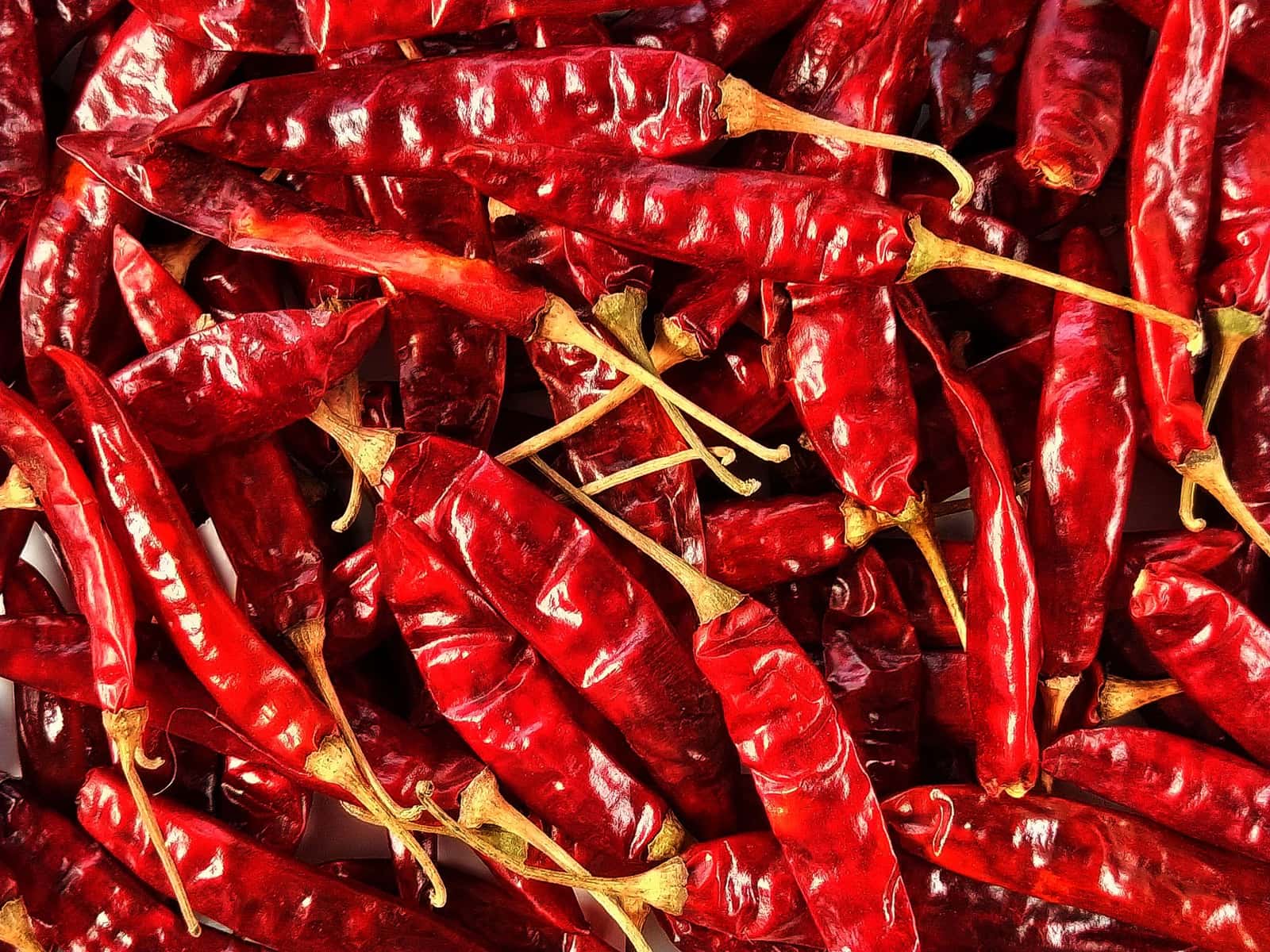
India’s largest spice export by volume. Dried red chilli goes to China, Thailand and Bangladesh; aflatoxin is the key test.
- HS code
- 0904.21 Dried chilli, neither crushed nor ground. Crushed or ground chilli is 0904.22; fresh green chilli is 0709.60.
- Export policy
- Free to export Free. CRES from the Spices Board is compulsory for dried chilli. Fresh green chilli for the EU must go through APEDA’s VegNet traceability system (APEDA circular, 18 Mar 2026).
- Registrations
- 5 IEC, GST and those below
- India’s exports, 2025-26
- US$ 1.1 bn to 116 countries
What is exported
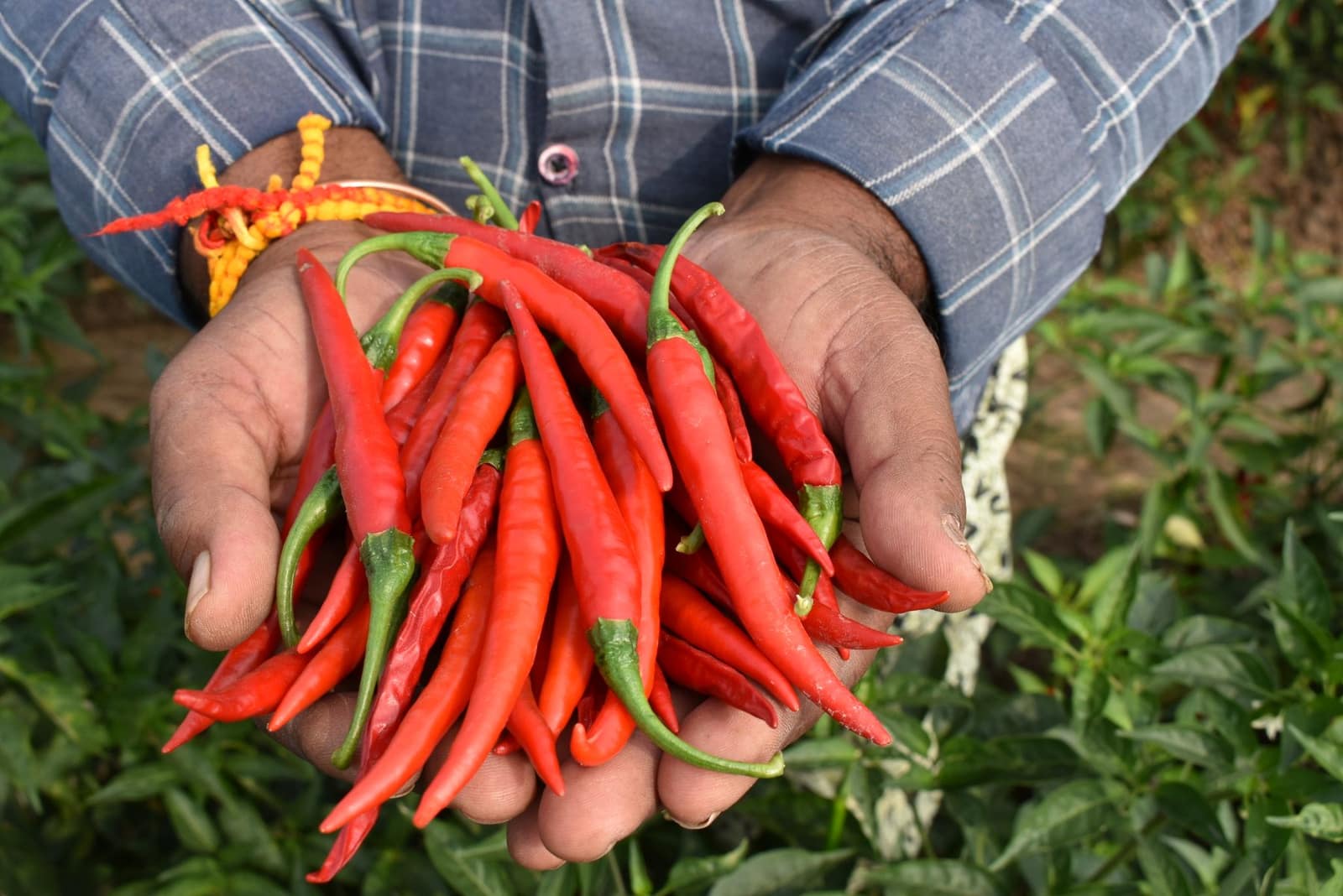
India exported 6.84 lakh tonnes of chilli in 2025-26 worth about US$ 1.18 billion (Spices Board). Andhra Pradesh, Telangana and Karnataka supply varieties such as Teja, 334 (Sannam) and Byadgi. China is by far the largest buyer, followed by Thailand, Bangladesh, the USA, Sri Lanka, the UAE, Indonesia and Malaysia. Buyers ask for stem-on or stemless whole chilli, crushed flakes or powder graded by colour (ASTA) and pungency.
Varieties, grades and forms
- Teja (S17)Very hot, bright red; the bulk variety for China and South-East Asia.
- 334 / Sannam (S4)Medium heat; the classic Guntur export chilli (Guntur Sannam is a GI).
- Byadgi (Kaddi and Dabbi)Deep colour, low heat; bought for colour extraction and paprika-style use.
- Warangal Chapata (Tomato chilli)High colour, low pungency, Telangana; registered as a GI in 2025.
- Stemless whole, crushed and powderForms graded by ASTA colour units and pungency (SHU).
Where it is grown or made
- Andhra PradeshGuntur — the largest chilli market yard; Prakasam and Krishna also grow for export.
- TelanganaWarangal and Khammam (Teja and Chapata).
- KarnatakaByadgi market in Haveri district; Ballari and Raichur.
- Madhya PradeshNimar region (Khargone, Dhar) — third-largest chilli state by area.
The quality buyers ask for
- Colour value
- Stated in ASTA colour units, measured by the ASTA extractable-colour method; drives the price of Byadgi-type and paprika chilli
- Pungency
- Scoville heat units (SHU), measured by HPLC as capsaicin content
- Form
- With stem, stemless, crushed or powder; stem and loose seed limits in the contract
- Aflatoxin and ochratoxin A
- EU: aflatoxin 5 ppb and ochratoxin A 15 ppb; Japan: aflatoxin 10 ppb; South Korea: ochratoxin A 7 ppb (Spices Board compilation)
- Ethylene oxide and dyes
- EU: ethylene oxide 0.02 mg/kg; artificial colour prohibited (Taiwan names it); Sudan dyes absent
- Standard
- Codex standard for dried or dehydrated chilli pepper and paprika (CXS 353-2022); AGMARK spice grades
Certificates
- Spices Board CRESRequiredCertificate of Registration as Exporter of Spices. Required by law before you export any spice listed by the Spices Board.
- FSSAI licenceRequiredCentral licence from FSSAI for the premises where the food is packed or stored for export. Apply on FoSCoS.
- Phytosanitary certificateRequiredIssued by Plant Quarantine (DPPQS) for each consignment of plant produce, after inspection. Apply on PQMS.
- Aflatoxin pre-shipment clearance (Sri Lanka)RequiredWhole chilli to Sri Lanka goes through the Spices Board’s pre-shipment testing and clearance for aflatoxin.
- APEDA VegNet (fresh green chilli to the EU)RequiredFresh green chilli for the EU must be traced and tested through APEDA’s VegNet (circular, 18 Mar 2026).
- HACCPOften askedA food-safety plan that identifies hazards at each processing step and controls them. Most importers ask for it from the processing unit.
- ISO 22000 / FSSC 22000Often askedFood-safety management system certification. FSSC 22000 is recognised by GFSI, which large retailers and brand owners look for.
Shipping, storage and shelf life
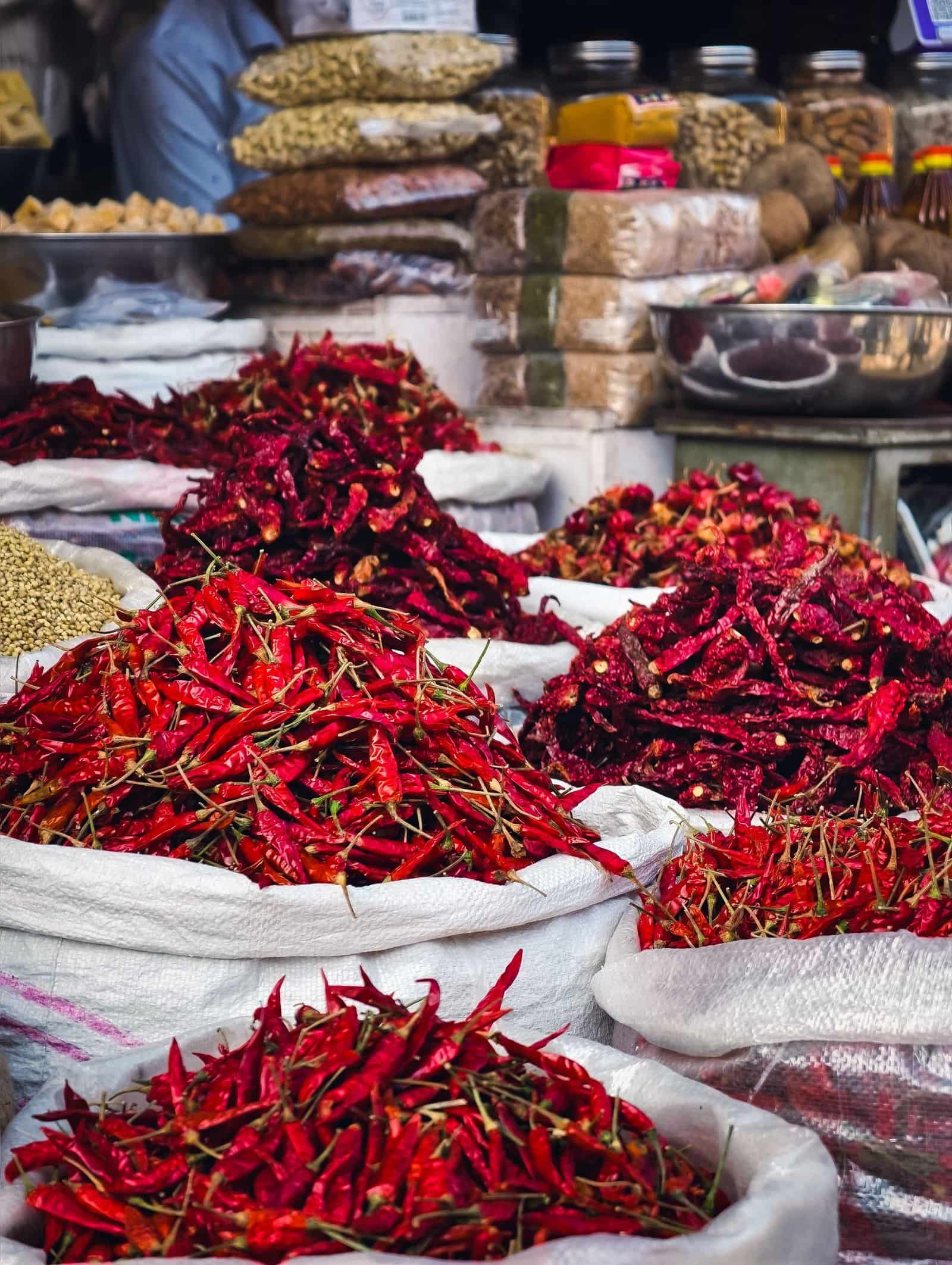
Whole dried chilli is bulky: it is pressed into bales or bagged and shipped in 40-ft high-cube containers, typically about 12–14 tonnes. Powder and crushed chilli fill a 20-ft box much more densely.
Sea freight from Chennai, Visakhapatnam and Krishnapatnam for Andhra and Telangana chilli; air for green chilli.
Cold storage at Guntur and other hubs holds dried chilli for months and protects colour. Keep moisture low; damp chilli grows mould and aflatoxin.
Whole dried chilli typically about a year in cold storage; powder less.
What goes on the pack and carton
- Bulk bags and cartons: product and grade, crop year, lot number, net and gross weight, “Product of India”, exporter name and the buyer’s shipping marks, matching the invoice and packing list exactly.
- EU retail packs (Regulation 1169/2011): name of the food, ingredients with allergens highlighted, net quantity, best-before date, storage conditions, the EU importer’s name and address, and origin where required — in the language of the country of sale.
- USA (21 CFR 101): product name, net quantity in both US and metric units, ingredients, allergens, name and place of business of the packer or distributor, Nutrition Facts unless exempt; and “Product of India” marking (19 CFR 134).
- Lot or batch number on every pack and bag — FSSAI’s Labelling and Display Regulations, 2020 require it, and every importing country uses it to trace and recall.
The Spices Board runs quality evaluation laboratories in Kochi, Mumbai, Chennai, Guntur, Narela (Delhi), Tuticorin, Kandla, Kolkata and Jodhpur; fees and sample forms are on indianspices.com → Quality. NABL-accredited private labs (search nabl-india.org) are also used. Check the Board’s “Mandatory tests for export” list for your spice and market.
Benefits of exporting this product
- RoDTEP refund on this line
Dried capsicum chilli, neither crushed nor ground (0904 21 10): 0.9% of FOB. Chilli powder (0904 22 11 and 0904 22 19): 1%. No value cap. Rate as listed in Appendix 4R (w.e.f. 10 Oct 2024); DGFT Notification 41/2026-27 keeps the rates in force on 30 Sep 2026 unchanged until 31 Dec 2026. Check your exact 8-digit line on dgft.gov.in before you price.
DGFT — Appendix 4R, RoDTEP schedule for DTA exports w.e.f. 10 Oct 2024 (Notification No. 32, 30 Sep 2024) ↗ - Chilli GIs
Registered chilli GIs include Guntur Sannam and Byadagi (held by the Spices Board), Bhiwapur, Nandurbar Mirchi, Warangal Chapata, Naga Mircha, Mizo and Khola chilli.
Spices Board — List of GI tags registered for spices (as of 15 Sep 2026) ↗ - Spices Board SPICED scheme
The Spices Board runs its development and export-promotion programmes under the SPICED scheme. For 2026-27, applications opened online on 1 July 2026, and the last date for the development and promotion programmes was 31 October 2026. Watch the Board’s scheme page for the next call.
Spices Board — SPICED scheme programmes for 2026-27 (online applications) ↗
Where to register
- Spices BoardCertificate of Registration as Exporter of Spices (CRES). Required by law for anyone exporting a spice listed by the Spices Board.indianspices.org.in ↗
- FSSAIFood business licence. FSSAI rules put food exporters under the Central licence; apply on FoSCoS and keep it valid for the premises you pack from.foscos.fssai.gov.in ↗
- APEDA (fresh green chilli)RCMC and VegNet farm/packhouse registration if you export fresh green chilli, especially to the EU.apeda.gov.in ↗
Quality and checks
- Aflatoxin (EU limit 5 µg/kg) and ochratoxin A (15 µg/kg) — caused by damp storage and drying on bare ground.
- Pesticide residues and ethylene oxide (EU 0.02 mg/kg on chilli products).
- Salmonella absent in 25 g for the EU and Australia; Sudan dyes and other illegal colours must be absent.
Buy graded stemless chilli in Guntur, get it tested for aflatoxin and residues, and ship one container to a Bangladesh or Sri Lanka buyer against LC. Once you have a clean record, approach the UAE and UK packers for powder.
Where new exporters go wrong
- Storing chilli in damp godowns before shipment — aflatoxin rises fast and the lot fails at destination.
- Adding colour or oil to improve appearance; this is treated as adulteration and leads to alerts.
Documents this product needs
Schemes that apply
Sources (4)
- Spices Board — Major item/country-wise export of spices (2021-22 to 2025-26)
- Spices Board — SPS requirements for spices (risks reported in export consignments)
- Spices Board India — exporter registration (CRES) and quality
- APEDA — Circular on Veg.Net for drumstick and green chilli exports to the EU (18 Mar 2026)
Trade data
Indian chilli exports in numbers
From the Department of Commerce’s TradeStat, country by country. US$, Indian financial years (April–March).
- Exports in 2025-26
- US$ 1.1 bn -1.6% a year on average, 2020-21 to 2025-26
- Change from 2024-25
- ↓ -12.9% US$ 1.26 bn → US$ 1.1 bn
- Buyer countries
- 116
- Average export price
- US$ 1.93 per kg · 5,68,154 tonnes shipped · US$ 2.12 the year before
The price cycle
India’s average export price per kg each year (total value ÷ total quantity). Highest in 2022-23, lowest in 2025-26 — a 40% swing between them. Keep this swing in mind when you quote.
What next: a projection from the trend
The past trend carried forward — not a forecast by any authority. Sudden changes in policy, prices or demand are not in it.
Likely range US$ 1.04 bn to US$ 1.47 bn.
- Trend
- +0.3% a year
- Fit (R²)
- 0 — weak, read with care
- Based on
- 6 years of official figures
Method: a straight line through the logarithm of yearly exports (log-linear regression); range = ±1 standard error.
Biggest buyer countries
By value in 2025-26. Change is against 2024-25.
Where demand is rising and falling
Only countries that buy at least US$ 1 million or 1% of India’s exports of this product. Change from 2024-25 to 2025-26.
↑ High demand
- MexicoUS$ 15.7 mn → US$ 20.1 mn↑+27.8%
- Sri LankaUS$ 73.1 mn → US$ 81.5 mn↑+11.5%
↓ Low demand
- GhanaUS$ 14.6 mn → US$ 8.6 mn↓-41.5%
- United KingdomUS$ 23.3 mn → US$ 18.7 mn↓-19.8%
- ChinaUS$ 450 mn → US$ 361 mn↓-19.7%
- United States of AmericaUS$ 132 mn → US$ 107 mn↓-18.8%
- BangladeshUS$ 116 mn → US$ 94.9 mn↓-18.4%
- NepalUS$ 15.4 mn → US$ 12.6 mn↓-17.9%
- IndonesiaUS$ 77 mn → US$ 65 mn↓-15.5%
Which forms sell, and at what price
India’s exports by 8-digit tariff line, 2025-26. Average price = total value ÷ total quantity (TradeStat): the average of every shipment on that line, not the price of any one deal.
| Tariff line | Value 2025-26 | Change | Quantity | Average price |
|---|---|---|---|---|
Spices, fruits of the genus Capsicum or Pimenta, dried, neither crushed nor ground — of genus capsicum0904 21 10 | US$ 840 mn | ↓-11.8% | 4,58,131 tonnes | US$ 1.83 per kgwas US$ 1.98 |
Spices, fruits of the genus Capsicum or Pimenta, crushed or ground — chilly powder0904 22 11 | US$ 168 mn | ↓-16.1% | 75,945 tonnes | US$ 2.22 per kgwas US$ 2.49 |
Crushed or ground; other fruits of genus capsicum0904 22 19 · Spices, fruits of the genus Capsicum or Pimenta, crushed or ground | US$ 86.4 mn | ↓-16.2% | 32,188 tonnes | US$ 2.68 per kgwas US$ 3.15 |
Spices, fruits of the genus Capsicum or Pimenta, crushed or ground — other of genus pimenta0904 22 29 | US$ 1.8 mn | ↑+7% | 1,720 tonnes | US$ 1.06 per kgwas US$ 1.74 |
Spices, fruits of the genus Capsicum or Pimenta, crushed or ground — powder0904 22 21 | US$ 1 mn | ↓-45.7% | 117 tonnes | US$ 8.62 per kgwas US$ 4.65 |
Spices, fruits of the genus Capsicum or Pimenta, dried, neither crushed nor ground — of genus pimenta0904 21 20 | US$ 170k | ↓-78.2% | 52 tonnes | US$ 3.24 per kgwas US$ 3.58 |
The world market
Each country’s own recorded exports and imports in UN Comtrade, 2023 (the latest year nearly every country has reported).
- World imports
- US$ 2.87 bn 2023
- India among exporters
- #1 of 130 countries
- India’s share of world exports
- 40.2% US$ 1.34 bn
- Left for others to win
- US$ 1.99 bn exported by other countries
Top exporters — your competitors
- 1IndiaUS$ 1.34 bn 40.2%
- 2ChinaUS$ 906 mn 27.2%
- 3SpainUS$ 295 mn 8.9%
- 4PeruUS$ 176 mn 5.3%
- 5MexicoUS$ 96.9 mn 2.9%
- 6GermanyUS$ 57.2 mn 1.7%
- 7NetherlandsUS$ 31.1 mn 0.9%
- 8MyanmarUS$ 30.5 mn 0.9%
- 9USAUS$ 30.3 mn 0.9%
- 10TunisiaUS$ 24.9 mn 0.7%
Biggest buyers in the world
- 1USAUS$ 563 mn 19.6%
- 2ChinaUS$ 396 mn 13.8%
- 3ThailandUS$ 228 mn 7.9%
- 4MexicoUS$ 169 mn 5.9%
- 5MalaysiaUS$ 159 mn 5.6%
- 6SpainUS$ 159 mn 5.5%
- 7IndonesiaUS$ 125 mn 4.4%
- 8GermanyUS$ 97.5 mn 3.4%
- 9Sri LankaUS$ 97.3 mn 3.4%
- 10JapanUS$ 80.6 mn 2.8%
Opportunity: what these countries buy from the world, and from India
Each country’s own recorded imports in UN Comtrade, latest year it has reported. The long light part of each bar is demand other countries are filling today.
TradeStat’s 2023-24 quantities are double-counted, so that year is left out of the price. Sources: TradeStat — Export Import Data Bank, Department of Commerce · UN Comtrade database (United Nations Statistics Division) · Figures taken 29 October 2026.
Step by step
How to export chilli
India is the world’s largest exporter of dried chilli, and chilli is one of the Spices Board’s biggest export items. China is both a major buyer and a rival grower, alongside Pakistan, Myanmar and Peru for paprika-type peppers. Demand comes from Chinese, Thai and Sri Lankan food industries, oleoresin makers, and seasoning and sauce brands. The openings are high-colour and low-heat types for extraction, and clean, low-aflatoxin chilli for Europe and Japan.
- 01Choose the type for the buyer
Match the variety to the use: Teja for heat, Byadgi for colour, 334/Sannam for general use. Agree colour, SHU, stem and moisture.
- 02Buy from cold storage with records
Buy lots with known farm and storage history; mixed old and new crop causes colour and aflatoxin problems.
- 03Clean, sort and de-stem
Machine-clean, remove discoloured pods and stems as agreed, and pack in lined bags.
- 04Lab test every lot
Test aflatoxin, ochratoxin A, pesticide residues, Sudan dyes and, for powder, Salmonella. Sri Lanka-bound chilli goes through the Board’s aflatoxin clearance.
- 05Stuff, document and ship
Stuff the container, file the shipping bill and get the phytosanitary and origin certificates.
- 06Get paid and close the file
Send the original documents through your bank (or to the buyer if paid in advance). Once the money arrives, get the e-BRC and claim RoDTEP and drawback where they apply.
Meet buyers
Trade fairs
- Usually late January or FebruaryGulfoodDubaigulfood.com ↗
- October, in odd-numbered years (next: 2027)AnugaCologneanuga.com ↗
- October, in even-numbered years (next: 2028)SIAL ParisParissialparis.com ↗
- Held about every two years; month variesWorld Spice Congress (Spices Board)India (venue changes)worldspicecongress.com ↗
- MarchFOODEX JapanTokyojma.or.jp ↗
Questions
Questions about exporting chilli
What is ASTA colour and why does it matter?
Why is Indian chilli often stopped in Europe?
Stem or stemless — which sells better?
Can I export fresh green chilli?
How do I keep aflatoxin low?
Sources (6)
- Spices Board — SPS requirements for spices (risks reported in export consignments, with limits)
- Spices Board — Quality evaluation laboratories (9 locations)
- Spices Board — Major item/country-wise export of spices (2021-22 to 2025-26)
- Codex Alimentarius — list of standards
- APEDA — International Pesticide MRL Database
- APEDA — Fresh Fruits & Vegetables (VegNet circular for green chilli, 18 Mar 2026)
Who buys Indian chilli
All countries → APTACNYBeijingChinaHuge market, but mostly for raw materials. Food plants must be registered with GACC; fresh produce needs a protocol.From India 2025-26US$ 19.5 bn
 SAFTABDTDhakaBangladeshBig neighbour market for cotton, yarn, food and machinery. Mostly LC-based; land and sea routes.From India 2025-26US$ 10.6 bn
 USDWashington, D.C.United States of AmericaIndia's largest single-country export market. Strict FDA rules for food; extra 10% US duty on most goods since July 2026.From India 2025-26US$ 87.3 bn
 ISFTALKRSri Jayawardenepura Kotte (Colombo is the commercial capital)Sri LankaClose island market with India's oldest FTA. Buys food, medicines, vehicles, yarn and building materials.From India 2025-26US$ 5.52 bn
 CEPAAEDAbu DhabiUnited Arab EmiratesIndia's biggest Gulf buyer and a re-export hub for the Middle East and Africa. CEPA in force since 2022.From India 2025-26US$ 37.4 bn
 AITIGAIDRJakartaIndonesiaWorld's fourth most populous country. Buys Indian vehicles, steel, chemicals, groundnuts and meat; halal and BPOM rules for food.From India 2025-26US$ 4.49 bn
 CECAMYRKuala LumpurMalaysiaMulti-ethnic market with a large Indian-origin community. Halal expectations for food; CECA and AITIGA both apply.From India 2025-26US$ 6.83 bn
More in farm produce
All products → Free, with conditionsFarm produceBasmati riceIndia’s top agri export by value. Free to export, but every contract must be registered with APEDA first.HS1006.30Exports 2025-26US$ 5.67 bn ↓4.6%
 Free, with conditionsFarm produceNon-basmati riceHigh-volume staple sold mainly to Africa and Bangladesh. Export reopened in 2024–25, but contracts must now be registered with APEDA.HS1006.30Exports 2025-26US$ 5.86 bn ↓10.2%
 Free to exportFarm produceSpicesWhole, ground and blended spices. Spices Board registration (CRES) is compulsory; residue and ethylene oxide tests keep buyers.HS0904–0910Exports 2025-26US$ 3.12 bn ↓5.1%
 Free to exportFarm produceTurmericFingers and powder for food and health markets. Lead, residues and Salmonella are the main test points.HS0910.30Exports 2025-26US$ 327 mn ↓4.2%