

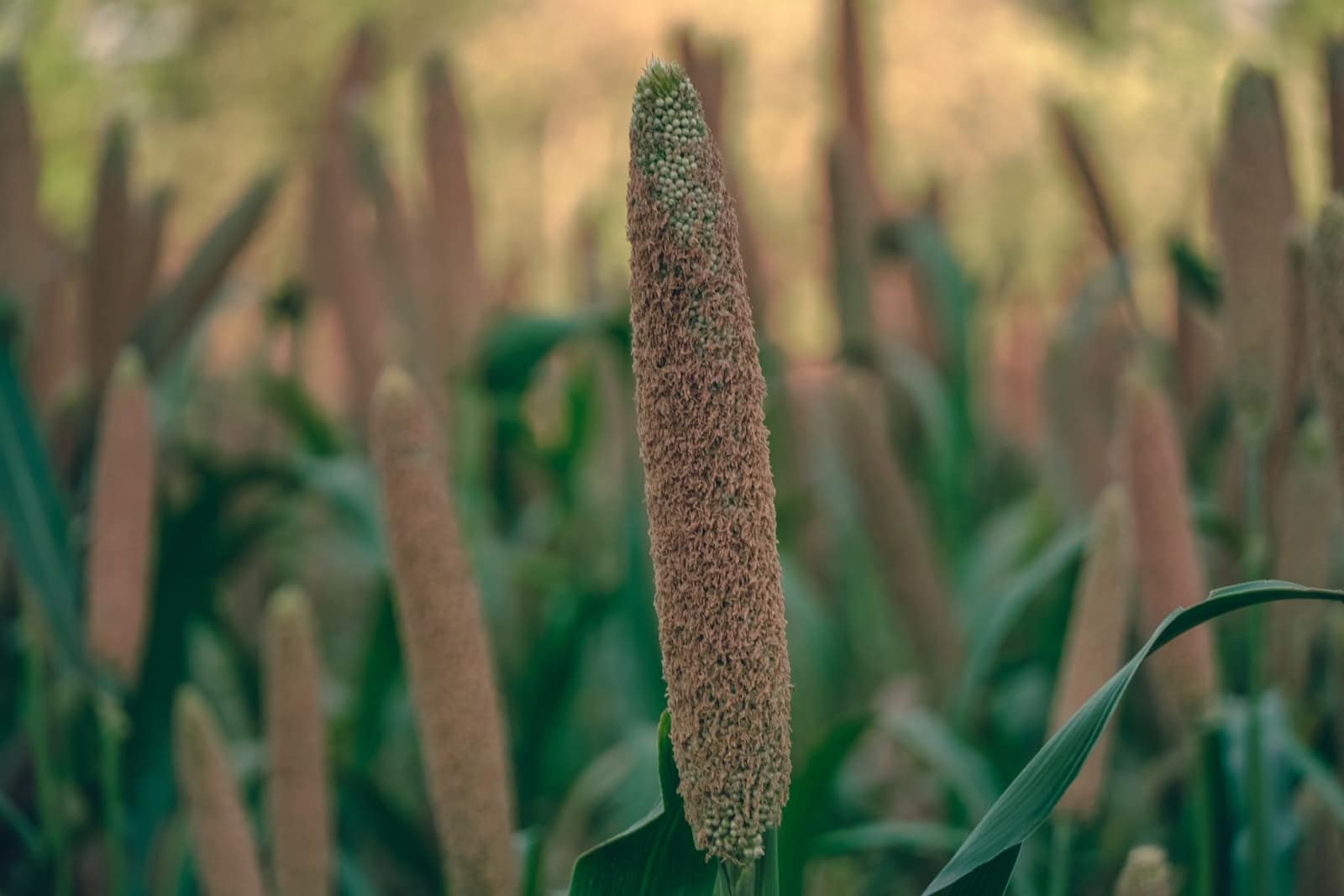
Farm produce
Export millets (shree anna)
Bajra, jowar, ragi and small millets as grain, flour and ready foods. Small but growing; the Gulf, Nepal and the USA buy most.
- HS code
- 1008 Buckwheat, millet and other cereals (pearl millet, finger millet and small millets). Sorghum (jowar) is 1007.
- Export policy
- Free to export Free, as far as we could confirm. Check the exact 8-digit line on DGFT’s ITC(HS) Schedule 2 before shipping.
- Registrations
- 5 IEC, GST and those below
- India’s exports, 2025-26
- US$ 67.2 mn to 88 countries
What is exported
India produced about 18.6 million tonnes of millets in 2024-25, led by Rajasthan, Maharashtra, Karnataka and Uttar Pradesh. Exports in 2025-26 were 1.39 lakh tonnes worth US$ 61.6 million. The UAE (22.4%), Saudi Arabia (12.7%), Nepal (7.8%), the USA (6.7%) and Morocco (3.8%) were the top destinations.


Varieties, grades and forms
- Pearl millet (bajra)Largest millet export; grain, flour and bird feed.
- Finger millet (ragi)Whole grain and flour for health and baby foods.
- Sorghum (jowar)Grain and flour; HS 1007, not 1008.
- Small millets — foxtail, kodo, little, barnyard, prosoEach has its own 8-digit line under 1008 21 / 1008 29.
- Ready-to-eat millet productsFlakes, noodles, cookies and mixes (Chapter 19).
Where it is grown or made
- RajasthanLargest producer (29.86%), mainly bajra in the west.
- Maharashtra13.62%; jowar in Marathwada and Solapur.
- Karnataka12.91%; ragi in the south (Tumakuru, Hassan, Mandya).
- Uttar Pradesh and GujaratUP 12.67%, Gujarat 7.25% — mainly bajra.
The quality buyers ask for
- Grade standards
- AGMARK Millets Grading and Marking Rules, 2024 (DMI); Codex standards for pearl millet (CXS 169-1989) and sorghum (CXS 172-1989)
- Moisture
- Set by the grade standard and contract; dry grain keeps and ships safely
- Foreign matter and damage
- Limits on other grains, stones, weevilled and damaged grains
- Mycotoxins
- Aflatoxin and other mycotoxins within destination limits; ergot is a risk in pearl millet
- Gluten-free claim
- Codex and EU rules allow “gluten-free” only at 20 mg/kg gluten or less — test for cross-contact with wheat
Certificates
- APEDA RCMCRequiredRegistration with APEDA, issued as an RCMC on the DGFT portal. Since 15 Sep 2026, a consignment up to ₹3 lakh FOB can go without it.
- Phytosanitary certificateRequiredIssued by Plant Quarantine (DPPQS) for each consignment of plant produce, after inspection. Apply on PQMS.
- FSSAI licenceRequiredCentral licence from FSSAI for the premises where the food is packed or stored for export. Apply on FoSCoS.
- Organic (NPOP / NOP / EU)Often askedNeeded only if you sell the product as organic: NPOP certification by an accredited body, plus the buyer market’s own organic rules.
- HACCPOften askedA food-safety plan that identifies hazards at each processing step and controls them. Most importers ask for it from the processing unit.
- Gluten-free certificationOften askedThird-party gluten-free scheme some retailers ask for; needs a dedicated or well-controlled line.
Shipping, storage and shelf life
Grain in 25 or 50 kg bags: a 20-ft container typically holds about 22–25 tonnes. Flours and foods go in cartons.
Sea freight from Mundra, Kandla and Nhava Sheva; land routes to Nepal.
Dry, fumigated godown. Pearl millet flour turns rancid quickly, so mill close to shipment or stabilise it.
Whole grain about a year; flours typically only a few months.
What goes on the pack and carton
- Bulk bags and cartons: product and grade, crop year, lot number, net and gross weight, “Product of India”, exporter name and the buyer’s shipping marks, matching the invoice and packing list exactly.
- EU retail packs (Regulation 1169/2011): name of the food, ingredients with allergens highlighted, net quantity, best-before date, storage conditions, the EU importer’s name and address, and origin where required — in the language of the country of sale.
- USA (21 CFR 101): product name, net quantity in both US and metric units, ingredients, allergens, name and place of business of the packer or distributor, Nutrition Facts unless exempt; and “Product of India” marking (19 CFR 134).
- Lot or batch number on every pack and bag — FSSAI’s Labelling and Display Regulations, 2020 require it, and every importing country uses it to trace and recall.
Use a laboratory on APEDA’s list of recognised laboratories (apeda.gov.in → Quality → Recognised Organisations). For any other test, search the NABL directory (nabl-india.org) for a lab accredited for that test, or use an FSSAI-notified lab. Ask the buyer which lab reports they accept before you send samples.
Benefits of exporting this product
- RoDTEP refund on this line
Bajra, ragi, jowar-under-1008 and small millets (1008 21 10 to 1008 29 99), and sorghum (1007 10 00, 1007 90 00): 0.9% of FOB, no value cap. Rate as listed in Appendix 4R (w.e.f. 10 Oct 2024); DGFT Notification 41/2026-27 keeps the rates in force on 30 Sep 2026 unchanged until 31 Dec 2026. Check your exact 8-digit line on dgft.gov.in before you price.
DGFT — Appendix 4R, RoDTEP schedule for DTA exports w.e.f. 10 Oct 2024 (Notification No. 32, 30 Sep 2024) ↗ - APEDA support (Bharat Krishi Niryat Yojana)
APEDA’s financial assistance scheme for 2026-27 to 2030-31 helps registered exporters, FPOs and processors with packhouses, cold chain and treatment plants, lab testing and quality systems, and market development (trade fairs, trial shipments, brand registration, retail listing fees). Read the component conditions before you spend.
APEDA — Bharat Krishi Niryat Yojana 2026-27 to 2030-31, operational guidelines (6 Oct 2026) ↗
Where to register
- APEDARegistration-cum-Membership Certificate (RCMC) for APEDA-scheduled products. Apply on the DGFT portal after you have your IEC.dgft.gov.in ↗
- FSSAIFood business licence. FSSAI rules put food exporters under the Central licence; apply on FoSCoS and keep it valid for the premises you pack from.foscos.fssai.gov.in ↗
- Plant Quarantine (DPPQS)Phytosanitary certificate for each consignment of plant produce, applied for online on PQMS. Some markets also need the farm, packhouse or mill to be registered with Plant Quarantine.pqms.cgg.gov.in ↗
Quality and checks
- Pesticide residues and mycotoxins (aflatoxin) against buyer limits.
- Cleaning to remove stones, dust and other grain; moisture under 12% or as contracted.
- For flours and ready mixes: shelf life, rancidity and the buyer country’s labelling rules.
Partner with a millet FPO that already cleans and packs. Send consumer packs of ragi or bajra flour, or cleaned small millets, LCL to a Gulf supermarket supplier. Since 15 September 2026, a consignment worth up to ₹3 lakh FOB does not need an RCMC (DGFT Notification 36/2026-27). Registrations that a law requires for the product still apply.
Where new exporters go wrong
- Millet flours turn rancid quickly; ship whole grain or use short best-before dates and good barrier packs.
- Using Indian names only on labels; buyers abroad need the English and botanical names.
Documents this product needs
Schemes that apply
Trade data
Indian millets (shree anna) exports in numbers
From the Department of Commerce’s TradeStat, country by country. US$, Indian financial years (April–March).
- Exports in 2025-26
- US$ 67.2 mn +9.5% a year on average, 2020-21 to 2025-26
- Change from 2024-25
- ↑ +19.9% US$ 56.1 mn → US$ 67.2 mn
- Buyer countries
- 88
- Average export price
- US$ 0.56 per kg · 1,19,515 tonnes shipped · US$ 0.56 the year before
The price cycle
India’s average export price per kg each year (total value ÷ total quantity). Highest in 2025-26, lowest in 2020-21 — a 39% swing between them. Keep this swing in mind when you quote.
What next: a projection from the trend
The past trend carried forward — not a forecast by any authority. Sudden changes in policy, prices or demand are not in it.
Likely range US$ 69.6 mn to US$ 86.1 mn.
- Trend
- +8.5% a year
- Fit (R²)
- 0.86
- Based on
- 6 years of official figures
Method: a straight line through the logarithm of yearly exports (log-linear regression); range = ±1 standard error.
Biggest buyer countries
By value in 2025-26. Change is against 2024-25.
Where demand is rising and falling
Only countries that buy at least US$ 1 million or 1% of India’s exports of this product. Change from 2024-25 to 2025-26.
↑ High demand
- MoroccoUS$ 560k → US$ 2.6 mn↑+364.3%
- SpainUS$ 960k → US$ 2.6 mn↑+169.8%
- NetherlandsUS$ 1.6 mn → US$ 3.5 mn↑+116.2%
- RussiaUS$ 1.9 mn → US$ 3.9 mn↑+103.2%
- Sri LankaUS$ 730k → US$ 1.4 mn↑+97.3%
- PolandUS$ 700k → US$ 1.3 mn↑+85.7%
- CanadaUS$ 1.2 mn → US$ 1.8 mn↑+50.4%
- United KingdomUS$ 1.7 mn → US$ 2.4 mn↑+41.6%
↓ Low demand
Which forms sell, and at what price
India’s exports by 8-digit tariff line, 2025-26. Average price = total value ÷ total quantity (TradeStat): the average of every shipment on that line, not the price of any one deal.
| Tariff line | Value 2025-26 | Change | Quantity | Average price |
|---|---|---|---|---|
Cereals, millet, other than seed — bajra1008 29 20 | US$ 19.7 mn | ↑+1.3% | 55,105 tonnes | US$ 0.36 per kgwas US$ 0.39 |
Quinoa(chenopodium quinoa)1008 50 00 · Cereals, quinoa | US$ 14.2 mn | ↑+133.8% | 10,633 tonnes | US$ 1.33 per kgwas US$ 1.21 |
Cereals, millet, seed — bajra1008 21 20 | US$ 6.1 mn | ↑+88.6% | 12,332 tonnes | US$ 0.50 per kgwas US$ 0.50 |
Other cereals,other then seed qlty1008 90 90 · Cereals in chapter 10 | US$ 6.1 mn | ↓-12.4% | 6,765 tonnes | US$ 0.90 per kgwas US$ 0.82 |
Cereals, millet, other than seed — ragi1008 29 30 | US$ 5.9 mn | ↓-2.6% | 15,054 tonnes | US$ 0.39 per kgwas US$ 0.39 |
Cereals, millet, other than seed — amaranth1008 29 91 | US$ 5 mn | ↓-26.1% | 4,229 tonnes | US$ 1.19 per kgwas US$ 1.25 |
Cereals, millet, seed — ragi1008 21 30 | US$ 2 mn | ↑+16.8% | 3,423 tonnes | US$ 0.57 per kgwas US$ 0.58 |
Cereals, millet, seed — amaranth1008 21 91 | US$ 1.7 mn | ↑+630.4% | 1,464 tonnes | US$ 1.15 per kgwas US$ 1.19 |
Cereals, millet, other than seed — jawar1008 29 10 | US$ 1.5 mn | ↑+122.4% | 2,728 tonnes | US$ 0.55 per kgwas US$ 0.55 |
Cereals, millet, other than seed — foxtail1008 29 60 | US$ 1.1 mn | ↓-41.9% | 2,187 tonnes | US$ 0.49 per kgwas US$ 1.15 |
Cereals, millet, seed — jawar1008 21 10 | US$ 1.1 mn | ↑+11.6% | 1,876 tonnes | US$ 0.57 per kgwas US$ 0.75 |
Cereals, millet, other than seed — barnyard1008 29 40 | US$ 360k | ↑+125% | 513 tonnes | US$ 0.70 per kgwas US$ 1.51 |
Cereals, millet, seed — proso1008 21 50 | US$ 320k | ↑+1,500% | 564 tonnes | US$ 0.57 per kgwas US$ 1.66 |
Cereals, buckwheat — other buck wheat1008 10 90 | US$ 310k | ↓-11.4% | 513 tonnes | US$ 0.60 per kgwas US$ 0.71 |
The world market
Each country’s own recorded exports and imports in UN Comtrade, 2023 (the latest year nearly every country has reported).
- World imports
- US$ 1.1 bn 2023
- India among exporters
- #6 of 118 countries
- India’s share of world exports
- 5.4% US$ 58.8 mn
- Left for others to win
- US$ 1.02 bn exported by other countries
Top exporters — your competitors
- 1PolandUS$ 209 mn 19.3%
- 2CanadaUS$ 129 mn 12%
- 3PeruUS$ 100 mn 9.3%
- 4USAUS$ 88.6 mn 8.2%
- 5FranceUS$ 67.1 mn 6.2%
- 6IndiaUS$ 58.8 mn 5.4%
- 7Bolivia (Plurinational State of)US$ 57.3 mn 5.3%
- 8GermanyUS$ 47.2 mn 4.4%
- 9UzbekistanUS$ 40.4 mn 3.7%
- 10ChinaUS$ 26.1 mn 2.4%
Biggest buyers in the world
- 1GermanyUS$ 143 mn 13.1%
- 2USAUS$ 107 mn 9.8%
- 3NetherlandsUS$ 72.4 mn 6.6%
- 4SpainUS$ 71.9 mn 6.6%
- 5ChinaUS$ 63.2 mn 5.8%
- 6JapanUS$ 58 mn 5.3%
- 7ItalyUS$ 49.5 mn 4.5%
- 8BelgiumUS$ 41 mn 3.7%
- 9IndonesiaUS$ 37.4 mn 3.4%
- 10MexicoUS$ 35.2 mn 3.2%
Opportunity: what these countries buy from the world, and from India
Each country’s own recorded imports in UN Comtrade, latest year it has reported. The long light part of each bar is demand other countries are filling today.
TradeStat’s 2023-24 quantities are double-counted, so that year is left out of the price. Sources: TradeStat — Export Import Data Bank, Department of Commerce · UN Comtrade database (United Nations Statistics Division) · Figures taken 29 October 2026.
Step by step
How to export millets (shree anna)
India is a leading grower of millets — pearl millet (bajra), sorghum (jowar), finger millet (ragi) and small millets — and pushed them worldwide during the International Year of Millets 2023. In grain trade it competes with the USA, Argentina, Ukraine and Australia for sorghum and proso millet. Gulf countries, Nepal, Libya, Tunisia and other markets buy grain for food and feed, while health-food buyers in Europe, the USA and Australia want gluten-free millet flours and ready foods. The openings are value-added millet products and organic millets.
- 01Choose grain or product
Bulk grain is price-driven; flours, flakes and snacks earn more but need a food unit and labels.
- 02Source from FPOs
FPOs in Rajasthan, Karnataka, Maharashtra and Odisha can supply cleaned and graded grain.
- 03Clean and grade
Destone, clean and grade to the AGMARK or buyer standard.
- 04Test
Test mycotoxins, residues and, for gluten-free claims, gluten.
- 05Fumigate, ship, certify
Fumigate, stuff, file the shipping bill and get the phytosanitary certificate.
- 06Get paid and close the file
Send the original documents through your bank (or to the buyer if paid in advance). Once the money arrives, get the e-BRC and claim RoDTEP and drawback where they apply.
Meet buyers
Trade fairs
Questions
Questions about exporting millets (shree anna)
Which millet sells most abroad?
Can I call millet flour gluten-free?
Why is bajra flour hard to export?
Is millet export free?
Is organic certification worth it?
Sources (5)
Who buys Indian millets (shree anna)
All countries → CEPAAEDAbu DhabiUnited Arab EmiratesIndia's biggest Gulf buyer and a re-export hub for the Middle East and Africa. CEPA in force since 2022.From India 2025-26US$ 37.4 bn
 SARRiyadhSaudi ArabiaLarge Gulf market for rice, food and engineering goods. Strict SFDA food rules and SABER certification for regulated goods.From India 2025-26US$ 10.3 bn
 SAFTANPRKathmanduNepalOpen land border, rupee payments and a market that relies on Indian goods — an easy first market by road.From India 2025-26US$ 7.45 bn
 USDWashington, D.C.United States of AmericaIndia's largest single-country export market. Strict FDA rules for food; extra 10% US duty on most goods since July 2026.From India 2025-26US$ 87.3 bn
More in farm produce
All products → Free, with conditionsFarm produceBasmati riceIndia’s top agri export by value. Free to export, but every contract must be registered with APEDA first.HS1006.30Exports 2025-26US$ 5.67 bn ↓4.6%
 Free, with conditionsFarm produceNon-basmati riceHigh-volume staple sold mainly to Africa and Bangladesh. Export reopened in 2024–25, but contracts must now be registered with APEDA.HS1006.30Exports 2025-26US$ 5.86 bn ↓10.2%
 Free to exportFarm produceSpicesWhole, ground and blended spices. Spices Board registration (CRES) is compulsory; residue and ethylene oxide tests keep buyers.HS0904–0910Exports 2025-26US$ 3.12 bn ↓5.1%
 Free to exportFarm produceChilliIndia’s largest spice export by volume. Dried red chilli goes to China, Thailand and Bangladesh; aflatoxin is the key test.HS0904.21Exports 2025-26US$ 1.1 bn ↓12.9%